
IAN BREMMER

Expert on Global Political Risk, Best-Selling Author, President & Founder of Eurasia Group and GZERO Media


  • A thought leader on global political risk, credited with bringing it to financial markets and creating Wall Street's first index of its kind (GPRI)
  • Globally-recognized, respected advisor to leading executives, money managers, diplomats and heads of state
  • He is president and founder of Eurasia Group, the world's leading political risk research and consulting firm, and GZERO Media, a company dedicated to providing intelligent and engaging coverage of international affairs
  • Bestselling author offering analysis on the intersection between politics and markets
  • Foreign affairs columnist and editor-at-large at Time Magazine
  • Dubbed the “rising guru” in the field of political risk by The Economist
  • Named a Young Global Leader of the World Economic Forum, where he is the founding chairman of the Global Agenda Council on Geopolitical Risk
  • The youngest-ever national fellow at the Hoover Institution

Ian Bremmer is a political scientist who helps business leaders, policymakers, and the general public make sense of the world around them. He is the president and founder of Eurasia Group, the leading geopolitical risk advisory firm, and GZERO Media, a digital media company providing intelligent and engaging coverage of international affairs. Ian is an independent voice on critical issues around the globe, offering clearheaded insights through speeches, written commentary, and even satirical puppets (really!).

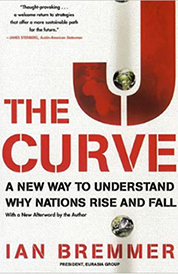
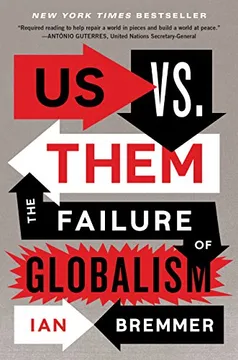
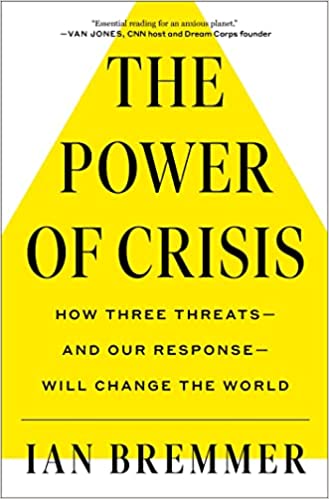
A prolific writer, Ian is the author of eleven books, including the New York Times bestsellers, “Us vs. Them: The Failure of Globalism,” which examines the rise of populism across the world, and his latest book, “The Power of Crisis: How Three Threats—and Our Response—Will Change the World,” which covers a trio of looming global crises (health emergencies, climate change, and technological revolution) and outlines their potential to create global prosperity and opportunity.

Ian is the foreign affairs columnist and editor at large for Time magazine, and is the host of GZERO World with Ian Bremmer, a global affairs program that airs weekly on US public television. Uniquely positioned to bring unbiased analysis on complex geopolitical issues, Ian is a frequent guest on leading broadcast television, digital news, and podcasts— from CNN and MSNBC to FOX and Newsmax— as well as key international media. Ian also served as rapporteur of the UN High-Level Advisory Body on Artificial Intelligence.

Ian holds a master's degree and a doctorate in political science from Stanford University and a bachelor's degree in international relations from Tulane University. He currently teaches at Columbia University's School of International and Public Affairs and previously was a professor at New York University. Ian is also a Senior Fellow at Harvard Kennedy School’s Belfer Center for Science and International Affairs.
Ian tailors each presentation to the needs of his audience and is not limited to the topics listed below. Please ask us about any subject that interests you:

  • Geopolitics
  • Financial Markets
  • Risk Management
  • American Politics
  • Global Economy
  • Emerging Markets
  • Energy Policy
  • New Global Order

The Power of Crisis

In a G-Zero world—one without strong and sustainable international leadership—crises no longer remain confined to one region or one issue area. They cascade across energy markets, supply chains, alliance systems, financial conditions, and domestic politics. Ian Bremmer argues that this is the defining challenge of the current era: not simply that crises are more frequent, but that the world is less capable of coordinating an effective response.

Ian discusses the geopolitics of...

  • War in Ukraine: How will the push for a negotiated end to the war—amid growing questions about territorial concessions, long-term deterrence, and Western security guarantees—shape the future of European security and the transatlantic alliance?
  • The Middle East and energy security: What does conflict in the Middle East reveal about the vulnerability of global shipping lanes, the risks surrounding the Strait of Hormuz, and the enduring power of regional conflict to send shocks through oil prices, inflation, and global business operations?
  • Climate and industrial resilience: How are climate pressures now intersecting with industrial policy, energy security, and strategic competition—especially as Europe and others try to localize production in critical sectors?
  • Tech: Ian assesses the growing risks of AI, quantum computing, cyberwarfare, and their impact on the future of government, trade, and the international system.

This talk explains why crisis management is now the central test of leadership for governments and companies alike—and how decision-makers can prepare for a world in which geopolitical shocks are more connected, more frequent, and harder to contain.

The Geopolitics of Artificial Intelligence

For most of human history, power belonged to whoever controlled territory, natural resources, and armies. In the coming century, it will belong to whoever controls artificial intelligence—the systems that will determine how economies grow, how militaries fight, how governments function, and how individuals understand the world around them.

That is not a prediction about a distant future. The decisions being made right now—about who builds these systems, who funds them, who they answer to, and what they optimize for—will be more consequential for the global balance of power than any election, any trade agreement, or any military alliance currently on the table.

Ian Bremmer will argue that AI is the most important geopolitical story of our time: not because of what it might do if it goes spectacularly wrong or right, but because of what it is already doing as it presently—simultaneously concentrating and diffusing power, reshaping competition, and programming human behavior at a scale that no previous technology has approached. Who—which business models, companies, and countries—sets the terms for this technology, and to what ends, is the question that will define the century.

Navigating the Geopolitical Recession

For the past two decades, the post-Cold War global order has been breaking down, leaving us to respond to a series of crises with both political, market, and business implications.  Today, that breakdown is no longer theoretical: it is reshaping trade, war, technology, energy markets, and the capacity of major powers to cooperate in real time. Ian Bremmer argues that we have moved from a G-Zero world into a more dangerous phase of geopolitical recession—one defined not simply by a vacuum of leadership, but by mounting rivalry, transactional diplomacy, and weaker guardrails between the world’s biggest powers.

The world’s most powerful country— the United States — has become the most politically dysfunctional rich-world country. The world's most important bilateral relationship — US-China —is deteriorating more quickly than leaders can build new guardrails. Today's global institutions no longer reflect the world's true balance of power. The result: a growing vacuum of leadership and cross-border coordination. This geopolitical recession will continue to limit our ability to respond to simultaneous crises from Russia-Ukraine war to the Middle East to climate change, and the emergence of disruptive new technologies. 

Ian will share ideas and insights to help policymakers and business decisionmakers navigate a world in accelerating transition.  

The next global superpower isn't who you think

Who runs the world? Bremmer argues it's not as simple as it used to be. With some eye-opening questions about the nature of leadership, he invites us to consider the impact of the evolving global order and our choices as participants in the future of democracy. 

Ian discusses how technology companies are becoming a vastly more important force in global politics, in many cases more powerful – and less accountable – than governments themselves… and their militaries. He covers the following topics:
               

  • We are now living in a leaderless world. Current geopolitical tensions and conflicts can be attributed to three things 1) Russia’s lack of integration into Western institutions 2) China’s integration into US-led institutions with the presumption that it would make the country more American (it didn’t) and 3) millions across the world feeling left behind by globalization.
  • What kind of order can we expect? There isn’t going to be one global system. Instead, there will be three world orders, separate but interconnected:
  1. The Security order (unipolar) led by the US
  2. The Economic order (multipolar) US, China, EU, Japan, India
  3. The Digital order

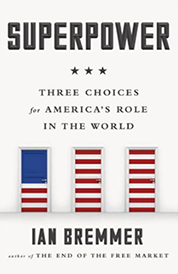
Superpower: Three Choices for America's Role in the World

Global policy expert Ian Bremmer calls for a complete rethink of America’s role in tomorrow’s world. In an increasingly volatile international environment, the question has never been more important. Bremmer explores three choices, each with its own benefits and drawbacks:

  • “Independent America” argues that it’s time for Washington to declare independence from the responsibility to solve everyone else’s problems. Instead, America should lead by example by investing in America’s enormous untapped potential;
  • “Moneyball America” acknowledges that we can’t manage every international challenge but asserts that we must defend U.S. interests wherever they’re threatened. It looks beyond phony arguments about American exceptionalism with a clear-eyed assessment of U.S. strengths and limitations; and,
  • “Indispensable America” insists that only Washington can promote the values on which global stability increasingly depends in our hyper-connected world. Turning inward would threaten America’s security and prosperity.

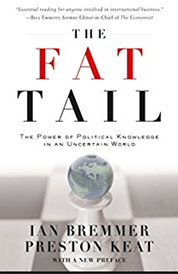
The Fat Tail: The Power of Political Knowledge for Strategic Investing

The fallout from the still-unfolding global financial crisis provides several perfect examples of "fat tail" risk, those that flow from the low-probability, high-impact events that generate upheaval more often than we think. Bremmer shares with audiences how an understanding of the political dynamics generated by the financial crisis helps us forecast market risks, why politics matter more than ever for market performance, why the world's wealthiest countries have begun to behave like emerging market states, and what all this means for investors and companies.

At this presentation audiences will learn:

  • The risks that flow from low-probability, high-impact events...like the global financial crisis.
  • Why politics matter more for the performance of markets and for issues ranging from defaults to nationalization to regulatory reforms.
  • Why developed states are behaving more like emerging markets.
  • The shift from New York, Shanghai, and Mumbai to Washington, Beijing and Delhi....and the risks that this trend creates.

Managing Risk in an Unstable World

To navigate globalization, every business decision-maker weighs economic variables when considering overseas investments or market exposure. But to spot crucial opportunities and manage risk, they must also understand the political factors and trends changing our world in real-time. Whether it's increasingly contentious relations between China and the United States, ongoing turmoil in the Middle East, the war in Ukraine, a more complex regulatory environment in Europe, a newly global focus from India, surges of populism in Latin America, heightened competition in Africa, or dozens of other politically driven trends, political analyst and entrepreneur Ian Bremmer will detail how political risk is creating new sets of business winners and losers. 

At this presentation audiences will learn:

  • How to identify political risks that can materially affect investment, operations, and supply chains
  • How to understand the new phase of US-China competition, from tariffs and export controls to strategic commodities and technology access
  • How to assess the geopolitical impact of conflicts in Ukraine and the Middle East on energy, shipping, and market stability
  • How to track the industrial and regulatory trends—especially in the US, Europe, and Asia—that are reshaping the global balance of power
  • How to incorporate AI, data, and digital sovereignty into enterprise risk planning

The Politics of Global Energy

Oil prices are increasingly susceptible to international politics--for both the world's supply and demand. Ian Bremmer, founder and president of the world's largest political risk consultancy, shares his views on what's in store for the politics of global energy--from spiraling Chinese and Indian growth in consumption to the dangers of future oil export from the Middle East, Russia and the Caspian, and West Africa.

At this speech audiences will learn:

  • Why international politics matters to oil investors, financial institutions, and consumers alike.
  • How to assess the real threats to oil production, and discount the headlines that don't matter.
  • How a shift in global relations between the US and China will affect the global energy market.

China, India, and Beyond: The Opportunities and Pitfalls of Asian Growth

China bestrides the world as a colossus, and business leaders can't get enough from the promised riches of Asia. But does unprecedented growth mean that your company will benefit from it? Ian Bremmer, intellectual entrepreneur and President of Eurasia Group, explains the dangers of Asian growth for global investors seeking to build a presence in international markets; for companies seeking to sell their products there; and for the global markets more broadly.

At this speech audiences will learn:

  • How to read the political and economic landscape in China, India, and beyond.
  • How geopolitics is creating greater risks--and opportunities--for investors in Asia.

America's Role in the 21st Century

America's global power was unchallenged in the immediate aftermath of the Cold War, but today international terrorism, nuclear proliferation, the rise of China, and an increasingly globalized world all pose threats to America's continued leadership. Eurasia Group President Ian Bremmer, founder of the world's largest political risk consultancy, discusses America's national interests, its foreign policy, and the potential for a shift to a multipolar world. The implications for world politics--and the global markets--are critical.

At this speech audiences will learn:

  • How America's foreign policy succeeds, and fails, in an increasingly globalized world.
  • Where America's national interests are critically challenged by international forces...and where it doesn't matter.
  • Who are the winners, and losers, if present world trends in politics and economic continue--in the United States and beyond.